



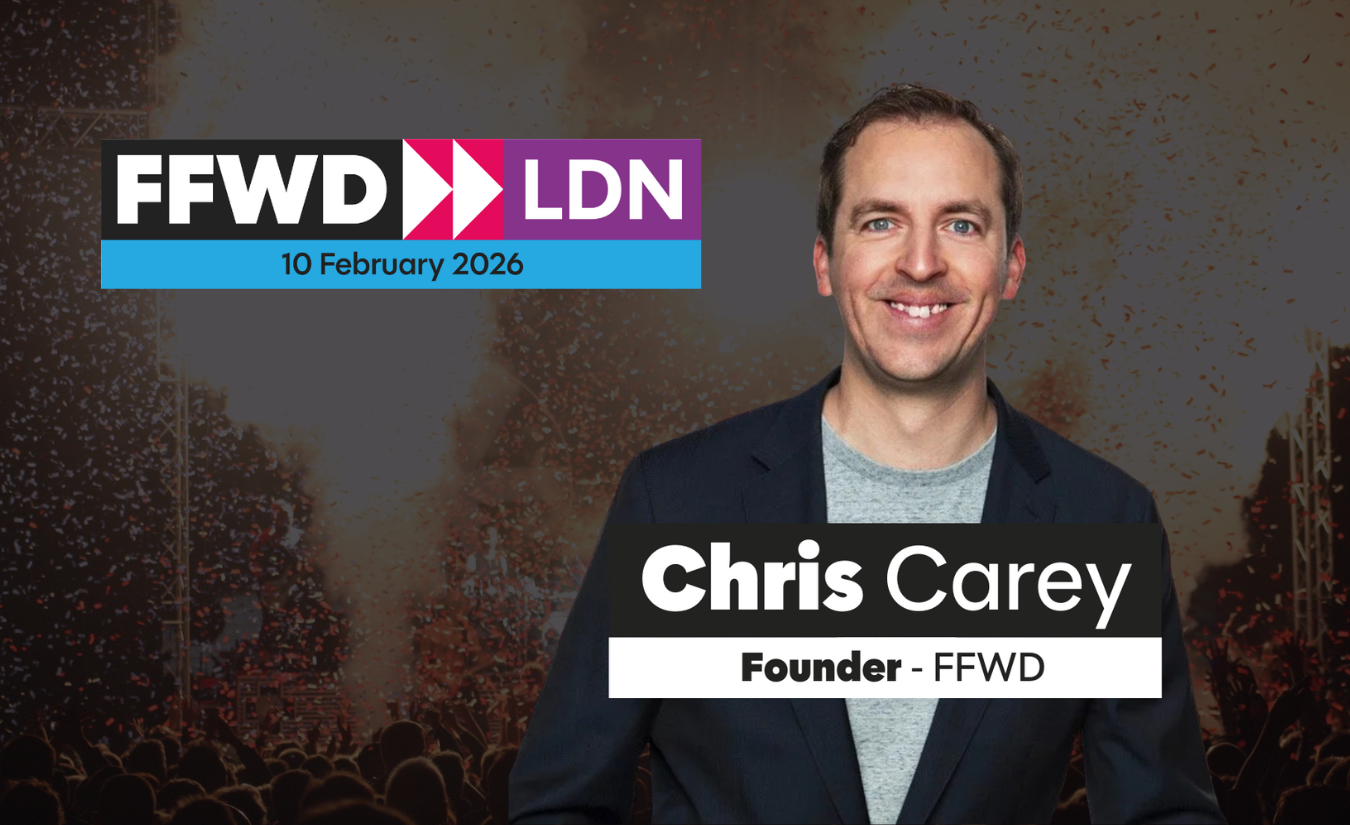
This Tuesday Synchtank will be sponsoring FFWD London, the 10th anniversary edition of the conference created by Chris Carey, Music Economist, Data Expert and Founder of FastForward.
As we approach the event, we sat down with Chris to look back at the last 10 years to see what has changed and what new challenges we now face, giving you an insight into discussions set to take place on the 10th February.
Rewind To 2016:
FFWD is 10 years old. If we rewind to the first edition, what problem was this event trying to solve back then?
Primarily it was to solve the lack of female speakers on conference line ups, which just drove me mad!
When I was in my 20’s I was lucky enough to be travelling around and speaking at many conferences across the globe but I was getting fed-up with the same faces and also how I was invited on to panels that I wasn’t especially expert in, and someone else probably should have had been offered that role instead of myself.
I was surrounded by amazing women and people in my day-to-day life who have a lot of things to say but weren’t given the microphone and opportunity to have their voice. Instead, I was watching the same people consistently speak at all the conferences across the world; from Barcelona, Paris to Austin, Texas.
FFWD was built to help rectify the lack of female representation on speaker line ups and to bring new voices to the conversation.
We’ve also broadened our inclusion focus beyond gender into ethnicity, neurodiversity, and sexuality, as well as accent variety and financial inclusion. We’re still learning, but its all in an effort to lift up an industry we all care so deeply about.
What belief about the music industry felt obviously true in 2016, but now feels completely wrong?
I think it has to be that we were under the impression that streaming was an extremely good and healthy thing for the future of the music industry.
When we think back to the history of music and technology, it’s often been that music was scared of technology. Let’s jump back to the gramophone for example, there was a fear of music being played without musicians. Instead, it was a powerful catalyst for music creation.
But the streaming model is different, I think the now seen consequences of streaming services are where choices are abundant, meaningful discovery is difficult, deep engagement with artists is more challenging still and where audiences are struggling to find new music to listen to consistently rather than a new song that comes and goes.
The biggest switch we have probably seen in the 10 years is new music being less relevant which would have been unthinkable in 2016.
I don’t have a time machine, but if we could ask algorithmic recommendation to deepen relationships with artists rather than diluting it across many, I think we would all be in a much better place.
Do you think radio and its model has changed at all from 2016 to 2026?
Radio tastemakers do the most amazing job of introducing artists with personality, character and with their own credentials to convince you that a song’s worth listening to more than once.
That human connection is lacking [from streaming] so it begs the question, does radio really need to change? I think that as music listening habits have evolved we’ve missed out on some of the best bits of radio.
I really like what Annie Mac is doing with Before Midnight, you’ve got a trusted personality bringing flavor, bringing context and bringing life to songs that are lively enough but don’t get the moment to be lively she breathing lighting to things it’s amazing.
Is the live boom sustainable, or are we already seeing cracks?
I think it’s incredible to see the appetite for live music and I think it’s good and healthy.
The challenge is making sure the spoils are spread across the whole value chain rather than just at the very top end. There’s been a pathway to get these artists to giant stadiums and arena shows, and that pathway has not been very well maintained.
So, is the boom sustainable? Financially yes, it probably keeps growing but is it healthy sustainable growth for the whole sector? That is a bigger question. The middle markets are struggling, the grassroots are struggling and it’s very important that some support goes back to the pathways that helped the industry get to where it is now.
The LIVE Trust are doing a good job of taking pounds off tickets for arenas and reinvesting that into talent as well as venues and that will be an important innovation that the UK is driving, which I expect we will see other nations adopt.
Let’s make sure those artists are getting the depth of support they need to build their career, to take control of their career and to build it and we’ll have a healthier ecosystem if we make pathways for talent to get to the successes that we’re seeing on the top end of the market.
Lastly, if we can get consumers to go out to live shows more often that helps everybody.
What does an artist need to understand today that they absolutely didn’t 10 years ago?
The importance of direct to fan and building your live audience. These elements were all there in 2016; live income overtook recorded music in 2009 in the UK, so growing your live audience and having a direct relationship with fans. It was absolutely prevalent then and is more important now as your other channels and ways of communicating breakdown and get drowned out, crowded out.
In 10 years, what will we laugh about thinking was important today?
One of my big concerns for AI music is that AI music will not be very good but the AI marketing of AI music will be very effective, as algorithms speak languages that we don’t speak. All the mystery that we pretend algorithms hold just because we don’t understand them is better understood by an AI trying to drive to a result.
Discovery by numbers is not working. There are good ways to use data, don’t get me wrong, but there’s some very bad ways and AI manipulation of those stats will make those very bad ways redundant.
FFWD 2026: All You Need To Know
FFWD (pronounced FastForward) is a music conference that is celebrating its 10th anniversary at Hackney Church on Tuesday 10th February 2026. Lunch will be provided and networking drinks after are encouraged (of course, in moderation) all to have a good time celebrating with some good people.
How has FFWD itself had to evolve over these 10 years?
We launched in Amsterdam where not a lot happens in February and an industry calendar that wasn’t so crowded that you couldn’t take a spot in a month not treading on anyone’s toes. (It was also) in a city that wasn’t popular except for Amsterdam’s dance event that happened September/ October time so miles away from February.
Our 15 minute specialist sessions representation is great for someone giving their debut or someone who’s PR team were nervous of them getting asked the questions, just a little format tweak opened doors.
We [FFWD] don’t market widely. The people who find us are the people we want to find us and so we leave breadcrumbs and we’ll be a bit louder (interviews like this makes us a bit louder and more visible) and we’ll raise the voice for the next 10 years. But the community we’ve built has been the people who are looking, who are on the front foot and who recognise that when a listener and speaker is speaking they know that person’s amazing.
We have a good track record of picking speakers, and the people who know the speakers and come along are those who are innovating and driving. We’re quite pleased to be a room of innovative, founders, entrepreneurs, creatives and change makers rather than a room of the usual suspects.
If someone comes to FFWD for the first time in 2026, what do you hope they walk away understanding?
I firstly hope everyone is extremely warmly welcomed in the room and that this is intended to be a space where people feel safe and you feel at home.
It’s a small enough room that you can get around everyone, you can know everybody and if you want to meet someone they’re in the same room as you all day. There’s a chance to meet people.
We want people to walk away with strategies for improving their current situation and the connections that can help them accelerate their career and the career of their artists/ writers/ producers, as a result of being at FFWD for the day.
What conversations does FFWD host that wouldn’t happen anywhere else?
A big topic is marketing which I mean, everyone talks about, but our framing on it is ‘are we seeing a return to old rules’; as AI takes over and breaks every metric, what happens to marketing? Will it be that we’re finally naturally going back to basics for marketing and is it back to old school? Questioning if old rules still apply and so while we’re very much future focused we’re not sure to learn from history. The quote ‘those who study history are those doomed to repeat it’, I say let’s not be those guys, let’s talk about it! With our expert panel; hosted by James Fleury , Darren Hemmings, Sammy Andrews, Kamille.
We’ve got a conversation about live, whether the future of live is forever going to be bigger and more expensive shows or whether actually they can be a democratization. Hosted by Thando Zulu, Sophie Kennard, Mark Davyd, Matthew Todd.
We also have friends interviewing friends, which having a conversation with a friend in front of people is, I think, quite a rare occasion for a conference. Normally other conferences have a well-known journalist meeting as someone having a conversation. I think the fact that we have people who have known each other for 20 years+, shared histories, shared experiences of growing up will make for really interesting conversation.
The other quirky thing we have is Will Page and I (two music economists) will be arguing about trends where we put five trends forward and we’ll see. This includes audience voting as we present two arguments, argue back and forth and ask the audience to vote for who wins!.
We also have a conversation on discovery, does discovery feel broken and how can we fix it.
Hosted by Karma Bertelsen, featuring Jamie Tagg, Perdi Higgs, Linda Coogan Byrne, and Connie Rose. Discussing, is discovery so broken and is it redeemable?
Lastly, we end with a whole room panel, as we feel that so many people in the room could have been on stage but the humility in the fact that they are just happy to be in the room as they know the day isn’t just about them. That’ll be fun.
FFWD London is going to be an event not to miss and we are so honoured to sponsor and show our support to the industry, speakers and Chris.
As a reminder, you can grab your tickets to FFWD here and use code ST10 for an 10% discount. We hope to see you there.

